
Find Your Lucky Star
In life, some people are more lucky than others. Events always seem to go their way. Did you ever wonder why that was? What if you could become one of them?

Reading time: 5 minutes
You thought you lived from your memory, but you mostly lived from your imagination.
— Romain Gary, in The Kites
A mentor wrote to me. After reading in The Common Trait of Great Leaders how his behavior became a source of inspiration for me, he said:
I wonder if it ever crossed your mind that what you seem to learn from others is actually your own mental construct, and that, really, all that inspiration in fact comes from one source — you.
Am I aware that the people I see as sources of inspiration may not be carrying the intentions I’m assigning to them? Yes.
This question is an opportunity to clarify my perspective on that topic, which is at the heart of this newsletter.
Events and their interpretation
First, the events that I refer to do happen. I don’t make them up. In fact, the amount of notes I take makes it likely that I remember some details quite accurately. For example, in the story I was sharing about this mentor, I’m quite confident about the details mentioned — his attitude, his words — because I wrote them down that very evening.
Second, different people trigger different reactions. At the time, I shared my problem with many people, and none of them triggered the new perspective that I got from discussing it with my mentor. What he did triggered something positive for me. Others didn’t.
Third, ultimately, it doesn’t matter what my mentor intended. I don’t control the events that happen to me, but I can influence my reaction to them. This approach to life is something that I may have inherited from my grandfather — whom I talked about before in Total Eclipse Of The Mind.
The lucky star of my grandfather
A couple of years before he died, I spent a nice day with my grandfather. Just him and I, visiting places he had lived in as a child, a teenager or a young adult.
He had decided to write a small essay about his life, to share it with his kids and grand-kids. I was helping him out in this project.
That day, we were jumping from one memory to another. Along this fragmented piece of storytelling, my grand-father kept referring to the influence that his lucky star had played on multiple occasions. He would conclude each story by repeating: “It’s simply amazing how lucky I’ve been during my whole life!”. Baffled by his stories, his enthusiasm and his joy of sharing the key moments of his life, I believed him.
Later, other moments of his life came to my mind, tougher ones. And I realized that, when he talked about them, he never blamed anyone. Not others. Not himself. Not even his lucky star that seem to have failed him.
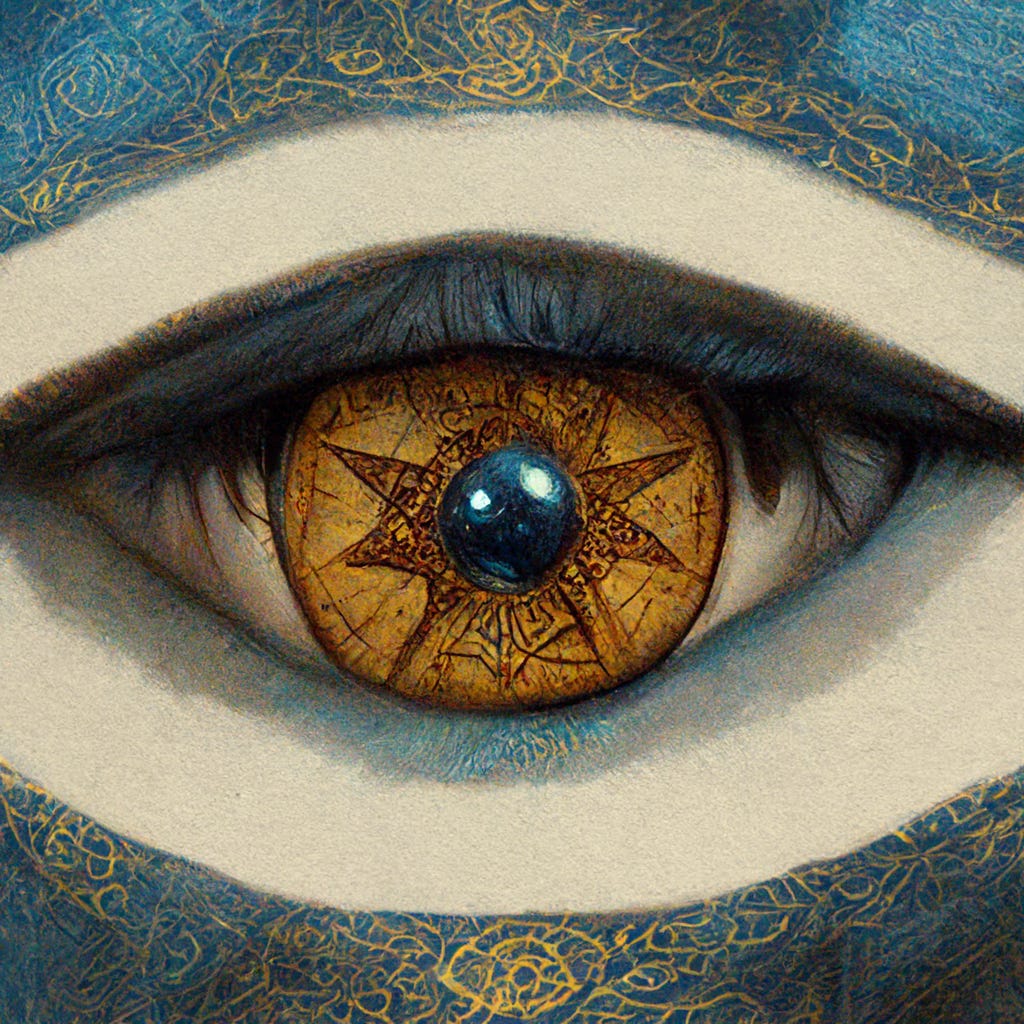
I don’t know if my grand-father was particularly lucky in life. However, I do believe that, indeed, a lucky star followed him his whole life. And it’s not a coincidence if it never left him, wherever he went, whatever he did — that lucky star was the one you could see constantly sparkling in his eyes. Hidden inside his gaze, it was coloring his life with a filter that was making it extraordinary.
His lucky star didn’t influence the events happening to him as much as it influenced his perception of those events.
How to find your own lucky star
I’ve been told that my newsletter usually lack conclusions. Here’s an attempt to unpack what you could take from this one:
Surround yourselves with sources of inspiration. If certain things or people trigger positive reactions within you, cherish them.
Acknowledge that your reaction to an event is not a logical, inevitable sequence, but a crossroad where you get to choose the interpretation of that event. When something happens to you, there are always two paths for you to take. The sum of the paths you take define your life journey, much more than the events that happen to you.
Develop the habit of flipping frustrations into opportunities — more about this in A Star Wars Object Shows Us How to Embrace 2021.
To explore this topic further
Some powerful art pieces have elaborated on this idea of choosing how to react to events.
An essay — Man's Search for Meaning, by Viktor Frankl, 1946. A prisoner in Nazi concentration camps describes his experiences and observations. One of the key conclusions was that, even if prisoners couldn’t influence their terrible living conditions, they could partially determine their own attitude towards them.
A poem — Invictus, by William Ernest Henley, 1888. A man facing leg amputation describes the dark journey his mind and his body go through. The last two lines (“I am the master of my fate / I am the captain of my soul”) have been reused in a speech by Winston Churchill in 1941, but it was Nelson Mandela who made this poem famous by reading it to other prisoners during his incarceration.
A movie — Big Fish, by Tim Burton, 2003. A son tries to understand who his dying father was, attempting to distinguish real events from invented memories. Beautiful, poetic movie, with a perfect ending.
Thank you to Pierre-Antoine Vertray for spreading an infectious passion for Romain Gary. Thank you to Maxime Mario for encouraging me to tell this story a long time ago.
Post-scriptum: If my grandfather was reading this, he would probably have the same reaction as my mentor.